

Pressure Independent Control Valves, PICVs, play a key role in ensuring accurate flow control, system stability, and energy efficiency in modern HVAC installations. Today, PICVs are available on the market in a wide size range - from DN10 up to DN300 - offered by a broad selection of suppliers.
The majority of PICVs on the marked are designed as one-unit PICVs, where the control function, pressure regulation and flow balancing are integrated into a single, compact body. FlowCon, however, takes a different approach in the smaller valve sizes. For valve dimensions up to and including DN32, FlowCon additionally offers insert-based PICVs, providing an alternative design philosophy that focuses on flexibility, serviceability, accuracy and performance transparency.
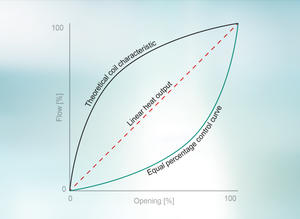
Within this insert-based concept, FlowCon offers two rolling diaphragm-based insert types: the FlowCon Green - a stepless adjustable solution with linear flow control characteristics and the FlowCon GreEQ - also a stepless adjustable solution, but with equal percentage (equal%) flow control characteristics. Both solutions are designed to deliver precise, pressure independent full stroke flow control with 100% authority while supporting different control strategies and application requirements.
To learn more about the many benefits of insert-based solutions for your HVAC project, explore our other FlowCon Topic Letters on the subject.

General Myths
In the HVAC market, several general myths circulate around inserts and cartridges, two concepts that are often treated as synonyms.
Myth 1:
Inserts will choke
Inserts are not more sensitive to choking or clogging due to water debris compared to one-unit PICVs. Debris is correctly an issue with regulation valves including PICVs but refers to the overall design and not whether the valve holds an insert construction or not.
All diaphragm-based PICVs (both one-units and insert-based) are subject to constant differential pressure across the orifice area. As most PICVs hold the same minimum ΔP and thereby roughly the same orifice area, they will all allow similar particle sizes to pass. However, the difference lays in the valve opening shape and related restriction. But PICV's orifice will in general malfunction due to roughly the same size debris.
Nonetheless, in case of blockage, inserts will allow the debris to be removed manually by removing the insert from the housing and rinsing the orifice area and capillary opening, whereas built-up valves will need to be replaced.
Myth 2:
Inserts cannot have stepless setting
Inserts come in both in pre-set and adjustable versions. The pre-set versions offer only one flow rate per insert, whereas the adjustable versions cover a range of flow rates in the same insert. Adjustable inserts are then again split into two versions, internal adjustable with settings in steps and external adjustable with stepless settings. In fact, stepless set PICV inserts from FlowCon are more the rule than the exception now a days as they offer more flexibility.
Myth 3:
Inserts are not suitable for modulating applications as they hold limited authority
This misconception confuses valve construction with valve performance. Insert describes how a valve is built, while Valve Authority describes how effectively it controls flow. The two are not inherently related. Whether a valve is insert-based - or not - does not determine its authority. Authority depends entirely on the valve's technology and design.
When insert-based PICVs are designed with diaphragm technology, such as the FlowCon Green and FlowCon GreEQ ranges, they provide 100% valve authority across the entire operating range. This makes them truly pressure independent control valves (PICVs) and an excellent choice for modula-ting applications.
A key advantage of FlowCon's PICV inserts is that full valve stroke is maintained regardless of the selected maximum flow setting. This ensures stable, accurate modulation, predictable control perfor-mance, and maximum authority under any load.
Myth 4:
Flow change requires an orifice change
Well, yes - obviously. A required change in max. flow, requires an orifice change, but this can be done through the valve setting. The need to purchase new inserts is very rarely required, and this is not exclusive to insert-based solutions.
A flow change is easy to set on FlowCon's PICV inserts, even with the system running and in operation. Should a change be required, it is significantly easier with a genuine insert, as used in the FlowCon PICV, rather than a full valve replacement.
Myth 5:
Insert technology is old and obsolete
Inserts are not just inserts. Inserts are basically a capsule for the technology, which is evolving continuedly. In FlowCon's world the insert-design is old, as it is the foundation of our business idea, but old isn't equal to obsolete or outdated. In fact, this proves that the insert concept is well tested, market proven, and a technology which is still going strong, with the insert benefits being recognized wider over time. And we continue to develop and evolve solutions around this core idea.
Myth 6:
Inserts are only available for lower pressure ranges up to 400 kPaD
This is not correct. In fact, the available differential pressure range for FlowCon's PICV inserts is wide and extends well beyond 400 kPaD reaching either 600 or 800 kPaD depending on model.
Conclusion
It is FlowCon's aim that this Topic Letter will provide new insight into the insert topic and at the same time dispel a few myths. If you are curious about the many advantages of choosing insert-based solutions, please feel free to contact us for further assistance or any clarification. We are here to help you and your next HVAC project.

FlowCon 最新文章
显示所有文章

PICV Inserts and General Myths
PICV Inserts: Separating facts from fiction in HVAC hydronic control.

Sustainability and PICVs
Sustainability in HVAC is no longer optional - it is fundamental to responsible system design
Importance of Control Curves in PICVs
Equal percentage control vs. linear control – which is better when and why?